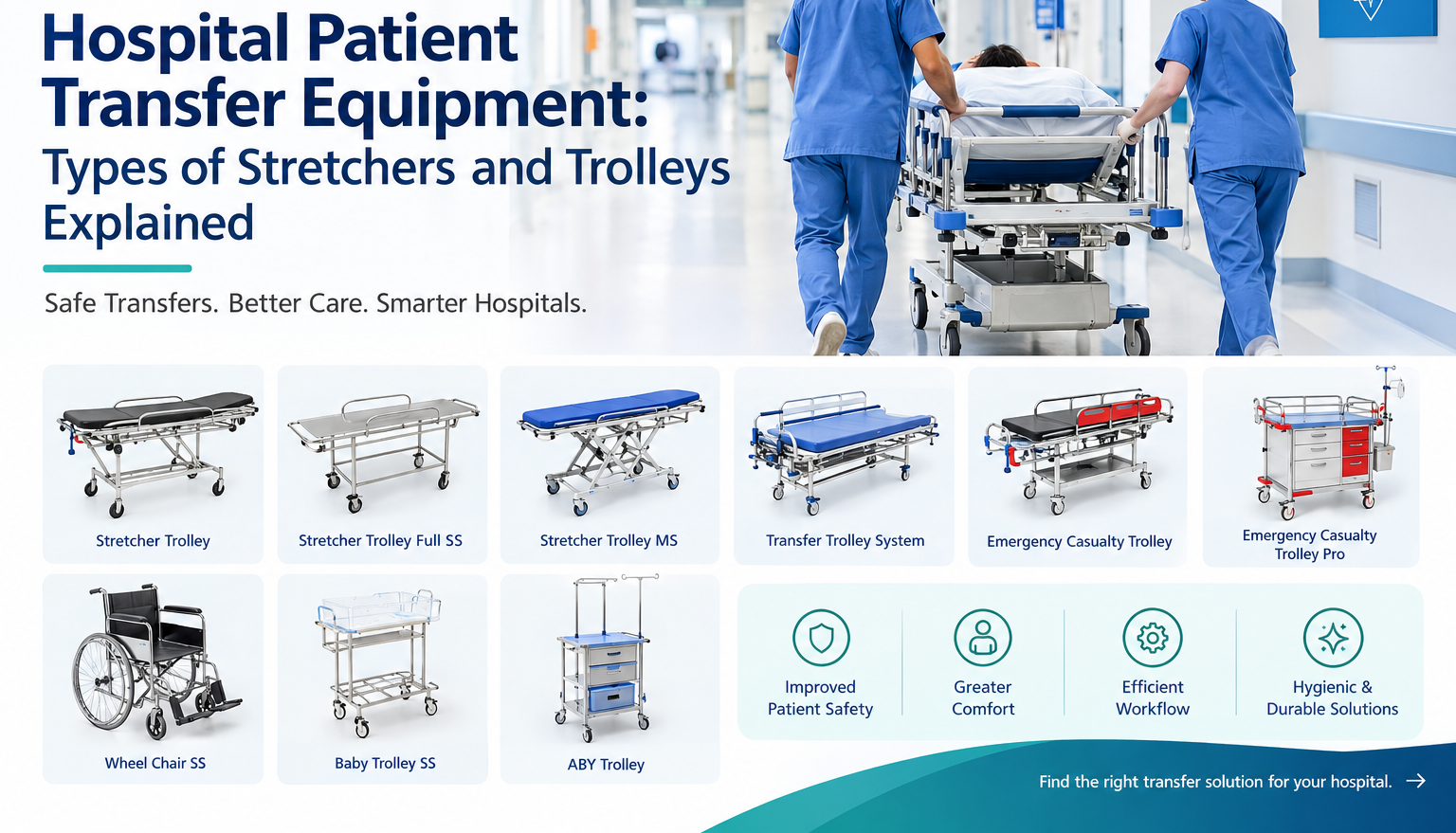
Moving patients safely and efficiently is an essential part of hospital operations. From transferring a patient from the emergency department to the operating room to moving patients between wards, diagnostic areas, and treatment rooms, hospitals require reliable patient transfer equipment designed for different clinical situations.
Hospital stretchers, stretcher trolleys, transfer trolleys, emergency casualty trolleys, wheelchairs, and specialised baby trolleys all play different roles in patient transportation. Selecting the appropriate equipment can help healthcare staff improve patient safety, mobility, comfort, and operational efficiency.
With hospitals handling patients with different mobility levels and medical requirements, there is no single transfer solution suitable for every situation. The right equipment depends on the patient's condition, department, transfer distance, frequency of use, and the type of movement required.
This guide explains the major types of hospital patient transfer equipment, their applications, and the factors hospitals should consider when selecting stretchers and trolleys.
What Is Hospital Patient Transfer Equipment?
Hospital patient transfer equipment refers to the furniture and mobility solutions used to safely move patients within a healthcare facility.
Patients may need to be transferred between:
- Emergency departments and wards
- Wards and operating rooms
- Patient rooms and diagnostic departments
- Intensive care areas and treatment rooms
- Recovery areas and procedure rooms
- Hospital entrances and clinical departments
Depending on the patient's condition, hospitals may use a stretcher trolley, transfer trolley, wheelchair, emergency casualty trolley, or specialised trolley.
The primary purpose is to provide a controlled and practical method of moving patients while reducing unnecessary physical effort for healthcare staff.
Why Is Patient Transfer Equipment Important in Hospitals?
Patient movement is a frequent activity in healthcare facilities. Without suitable equipment, transferring patients can become physically demanding for hospital staff and uncomfortable for patients.
Well-designed transfer equipment can support several important requirements.
Patient Safety
A stable and suitable transfer solution helps provide controlled movement during transportation. The equipment selected should match the patient's condition and the type of transfer being performed.
For example, a patient who cannot walk independently may require a stretcher trolley rather than a standard wheelchair.
Better Patient Comfort
Patients may spend considerable time on a stretcher or trolley while waiting for procedures, transportation, diagnosis, or treatment. Appropriate equipment can therefore contribute to a more comfortable transfer experience.
Easier Movement for Healthcare Staff
Hospitals can involve long corridors, multiple departments, lifts, ramps, and busy clinical areas. Equipment designed for mobility and manoeuvrability can make routine patient transportation easier for staff.
Efficient Hospital Operations
Patient transfers are part of everyday hospital workflow. Suitable equipment can support smoother movement between departments and help staff manage transportation more efficiently.
Hygiene and Maintenance
Hospital equipment is regularly exposed to patients, healthcare environments, and cleaning procedures. Surfaces and construction should therefore be suitable for regular cleaning and maintenance.
Types of Hospital Patient Transfer Equipment
Hospitals use different types of transfer equipment according to the patient's condition and transportation requirements.
1. Hospital Stretcher Trolley
A hospital stretcher trolley is one of the most commonly used patient transportation solutions.
It is designed for patients who need to remain lying down while being moved through the hospital. Stretcher trolleys can be used for routine transportation as well as in departments where patients require movement between different clinical areas.
Typical applications include:
- Moving patients between hospital departments
- Emergency patient transportation
- Diagnostic procedures
- Pre-operative and post-operative movement
- Ward-to-treatment-room transfers
The appropriate stretcher should provide stability, ease of movement, and a practical design for healthcare staff.
2. Stretcher Trolley Full SS
A full stainless steel stretcher trolley full ss is designed for healthcare environments where durability and ease of cleaning are important considerations.
Stainless steel is widely used in healthcare furniture because of its suitability for regular cleaning and its resistance to corrosion under appropriate conditions.
Full SS stretcher trolleys can be considered for hospitals, clinics, emergency areas, and other healthcare environments where frequent use and cleaning are expected.
3. Stretcher Trolley MS
A mild steel stretcher trolley, commonly referred to as an MS stretcher trolley, is another option for patient transportation.
These trolleys are intended for moving patients who need to remain on a stretcher during transportation. They can be considered for hospitals and healthcare facilities looking for practical patient mobility equipment.
When selecting an MS stretcher trolley, hospitals should consider the construction quality, surface finish, mobility, cleaning requirements, and intended frequency of use.
4. Transfer Trolley System
A patient transfer trolley system is designed specifically around the movement of patients within a healthcare facility.
Transfer trolleys can be particularly useful where patients need to be moved frequently between departments.
The selection should take into account:
- Patient type
- Transfer distance
- Hospital layout
- Frequency of transportation
- Staff handling requirements
- Cleaning and maintenance needs
A suitable transfer trolley can become an important part of the hospital's overall patient transportation workflow.
5. Emergency Casualty Trolley
Emergency departments require equipment that supports rapid patient movement and access.
An emergency casualty trolley is designed for patient transportation in emergency and casualty areas. It can be used when patients need to be moved quickly for assessment, treatment, observation, or further clinical care.
Emergency areas can involve unpredictable patient flow, making manoeuvrability and practical handling particularly important.
The equipment selected should be appropriate for the hospital's emergency department workflow and patient requirements.
6. Emergency Casualty Trolley Pro
The Emergency Casualty Trolley Pro is another solution within the emergency patient transportation category.
A hospital may consider specialised emergency trolley options when planning equipment for casualty departments, emergency rooms, and areas where rapid patient movement is required.
When comparing emergency casualty trolleys, healthcare procurement teams should assess the design, mobility, construction, cleaning requirements, and compatibility with the hospital's operational needs.
7. Wheelchair SS
Not every patient transfer requires a stretcher.
A stainless steel hospital wheelchair can be used for patients who are able to remain seated but cannot walk independently or need assistance while moving around the hospital.
Wheelchairs are commonly used for:
- Outpatient movement
- Ward transportation
- Diagnostic department visits
- Hospital entrance-to-department movement
- Patient discharge transportation
A wheelchair is generally more appropriate than a stretcher when the patient can safely remain in a seated position during transportation.
8. Baby Trolley SS
Paediatric and maternity departments may require specialised transportation equipment designed for infants.
A Baby Trolley SS can support the movement of babies within relevant hospital departments.
Baby transportation equipment should be selected according to the requirements of the maternity, neonatal, paediatric, or other relevant clinical areas.
Hospitals should consider stability, ease of movement, hygiene, construction, and the specific workflow of the department when selecting equipment for infant transportation.
Stretcher vs Transfer Trolley vs Wheelchair: What Is the Difference?
Although these products all support patient movement, their applications can differ.
| Equipment | Primary Use | Patient Position | Typical Application |
|---|---|---|---|
| Stretcher Trolley | Patient transportation | Lying | Wards, emergency, diagnostic areas |
| Transfer Trolley | Patient transfer | Usually lying | Inter-department movement |
| Emergency Casualty Trolley | Emergency transportation | Lying | Emergency and casualty departments |
| Wheelchair | Patient transportation | Seated | Outpatient and ward movement |
| Baby Trolley | Infant transportation | Lying/appropriate supported position | Maternity and paediatric areas |
The correct choice depends on the patient's mobility, medical condition, department, and transfer requirements.
How to Choose the Right Hospital Patient Transfer Equipment
Selecting hospital transfer equipment should be based on practical clinical and operational requirements rather than choosing a product based only on appearance or price.
1. Consider the Patient's Condition
The patient's condition should be the first consideration.
A mobile patient may be suitable for wheelchair transportation, while a patient who must remain lying down may require a stretcher trolley.
Hospitals should also consider whether the patient requires assistance from one or more healthcare workers during transportation.
2. Consider the Department
Different departments have different transportation requirements.
For example:
Emergency Department: Emergency casualty trolleys and stretcher trolleys may be required for rapid patient movement.
General Wards: Stretcher trolleys and wheelchairs can support routine transportation.
Diagnostic Departments: Patients may need to be transferred between wards and imaging or testing areas.
Operating Rooms: Stretcher and transfer solutions can support movement before and after procedures.
Maternity and Paediatric Areas: Specialised equipment such as baby trolleys may be required.
3. Evaluate Manoeuvrability
Hospitals have corridors, lifts, doorways, ramps, treatment areas, and crowded clinical environments.
A patient transfer trolley should therefore be practical to manoeuvre through the hospital's actual layout.
Before procurement, hospitals can evaluate how the equipment performs in:
- Narrow corridors
- Doorways
- Elevators
- Ramps
- Turns and corners
- Busy clinical areas
4. Check Construction and Durability
Hospital transfer equipment can be used repeatedly throughout the day.
Construction quality is therefore an important procurement consideration. Hospitals should evaluate the materials, frame construction, surface finish, wheels, joints, and other relevant components.
The expected workload and frequency of use should also be considered.
5. Consider Cleaning and Hygiene
Patient transfer equipment needs regular cleaning as part of hospital hygiene practices.
Smooth and accessible surfaces can make routine cleaning easier. Stainless steel equipment is often considered in healthcare environments because of its durability and suitability for cleaning when maintained appropriately.
Hospitals should establish cleaning procedures according to their infection-control protocols and the equipment manufacturer's recommendations.
6. Consider Staff Handling
The equipment should be practical for healthcare workers who use it every day.
Hospitals should evaluate factors such as:
- Ease of pushing
- Manoeuvrability
- Handling
- Stability
- Movement through doors and corridors
- Ease of cleaning
- Storage requirements
Staff feedback can be valuable before finalising procurement decisions.
Patient Transfer Equipment for Different Hospital Departments
A hospital may require a combination of transfer solutions rather than relying on a single equipment type.
Emergency and Casualty
Emergency departments can require stretcher trolleys and emergency casualty trolleys for patients who need rapid movement and assessment.
General Wards
General wards may require a combination of stretcher trolleys and wheelchairs for routine patient transportation.
Diagnostic Departments
Patients frequently travel between wards and diagnostic areas. Transfer trolleys, stretchers, and wheelchairs can support different patient mobility requirements.
Operating and Procedure Areas
Patients undergoing procedures may need to be transported while lying down, making stretcher and transfer trolley solutions relevant.
Maternity and Paediatric Departments
Specialised baby transportation equipment can be considered for moving infants within appropriate clinical areas.
The exact equipment mix should be determined by the hospital's patient profile, departments, layout, and workflow.
Indtech Healthcare Hospital Patient Transfer Solutions
Indtech Healthcare provides a range of products designed for patient transportation and transfer requirements.
The Hospital Patient Transfer Solutions collection includes:
- ABY Trolley
- Wheel Chair SS
- Transfer Trolley System
- Emergency Casualty Trolley
- Stretcher Trolley Full SS
- Stretcher Trolley
- Stretcher Trolley MS
- Baby Trolley SS
- Emergency Casualty Trolley Pro
This range allows healthcare facilities to consider different patient transportation requirements across emergency, ward, diagnostic, maternity, and other hospital environments.
When selecting equipment, hospitals should match each product to its intended application, patient type, department workflow, and transportation requirements.
Hospital Patient Transfer Equipment Procurement Checklist
Before purchasing hospital stretchers and trolleys, healthcare procurement teams can evaluate the following:
| Factor | What to Consider |
|---|---|
| Patient Type | Adult, paediatric, emergency, mobile or non-mobile |
| Equipment Type | Stretcher, transfer trolley, wheelchair or baby trolley |
| Application | Ward, emergency, diagnostic, operating or maternity |
| Mobility | Ease of movement and manoeuvrability |
| Construction | Material and overall build quality |
| Hygiene | Cleaning and maintenance requirements |
| Frequency | Occasional or continuous hospital use |
| Hospital Layout | Corridors, doors, lifts, ramps and turns |
| Staff Handling | Ease of pushing and operation |
| Maintenance | Cleaning, inspection and service requirements |
A structured evaluation helps hospitals select equipment based on actual operational requirements.
Conclusion
Hospital patient transfer equipment is an important part of efficient healthcare operations. Stretchers, transfer trolleys, emergency casualty trolleys, wheelchairs, and baby trolleys serve different patient transportation needs throughout a hospital.
The right solution depends on several factors, including the patient's condition, department, transfer method, hospital layout, equipment usage, cleaning requirements, and staff handling.
Instead of selecting a single type of equipment for every situation, hospitals can develop a combination of patient transfer solutions that supports different clinical workflows.
For hospitals planning new facilities, upgrading existing departments, or procuring patient transportation equipment, understanding the differences between hospital stretchers and trolleys is an important step toward making an informed equipment selection.
FAQs
1. What is hospital patient transfer equipment?
Hospital patient transfer equipment includes stretchers, stretcher trolleys, transfer trolleys, emergency casualty trolleys, wheelchairs, and specialised trolleys used to move patients safely within a healthcare facility.
2. What is the difference between a hospital stretcher and a wheelchair?
A hospital stretcher is generally used to transport patients who need to remain lying down, while a wheelchair is designed for patients who can remain seated during transportation.
3. What is a stretcher trolley used for?
A stretcher trolley is used to move patients who need to remain in a lying position between hospital departments such as wards, emergency areas, diagnostic rooms, and procedure areas.
4. What is an emergency casualty trolley?
An emergency casualty trolley is patient transportation equipment intended for emergency and casualty environments where patients may require rapid movement for assessment and treatment.
5. How do hospitals choose the right patient transfer trolley?
Hospitals should consider the patient's condition, department, transfer distance, hospital layout, manoeuvrability, construction, cleaning requirements, frequency of use, and staff handling needs.
6. Why is stainless steel used in hospital trolleys?
Stainless steel is commonly used in healthcare equipment because it offers durability and is suitable for regular cleaning and maintenance when properly maintained.
7. Which equipment is suitable for moving non-ambulatory patients?
Patients who cannot walk independently may require a stretcher trolley or transfer trolley, depending on their condition and the specific transfer requirement.
8. What patient transfer equipment is used in emergency departments?
Emergency departments may use stretcher trolleys and emergency casualty trolleys for transporting patients who require emergency assessment or treatment.
9. What equipment is used for infant transportation in hospitals?
Specialised equipment such as baby trolleys can be used for appropriate infant transportation within maternity, paediatric, or other relevant hospital departments.
10. What should hospitals check before buying patient transfer equipment?
Hospitals should evaluate patient requirements, equipment application, construction, manoeuvrability, cleaning, durability, staff handling, hospital layout, maintenance, and the expected frequency of use.